
Noble Vision, Heavy Hand
The MBTA Communities Act and the Towns Caught in the Crosshairs


The MBTA Communities Act was born from a noble idea: ease Massachusetts' housing crisis by encouraging multifamily housing near public transportation (mass.gov). In theory, it is a forward-looking effort to increase density, expand housing options, and create more equitable communities. But in execution, the state has turned a well-intentioned law into a weapon—holding towns hostage and threatening to cut off critical funding if they do not fall in line.
Across the Commonwealth, municipalities that don’t comply with the MBTA Communities Act face more than bureaucratic reminders—they face direct financial punishment. The message from Beacon Hill is clear: zone for dense housing near transit, or the state will withhold millions in vital grants. These aren’t abstract figures. We’re talking about money for infrastructure, economic development, and even public safety.
Several communities have pushed back, including Holden, Hanson, Duxbury, Milton, Middleborough, and Marshfield. Many of these towns do not even have MBTA stations, and yet they are being classified as "adjacent communities" and subjected to compliance mandates (boston.com). In some cases, residents at Town Meetings have overwhelmingly voted down proposed zoning changes required for compliance.
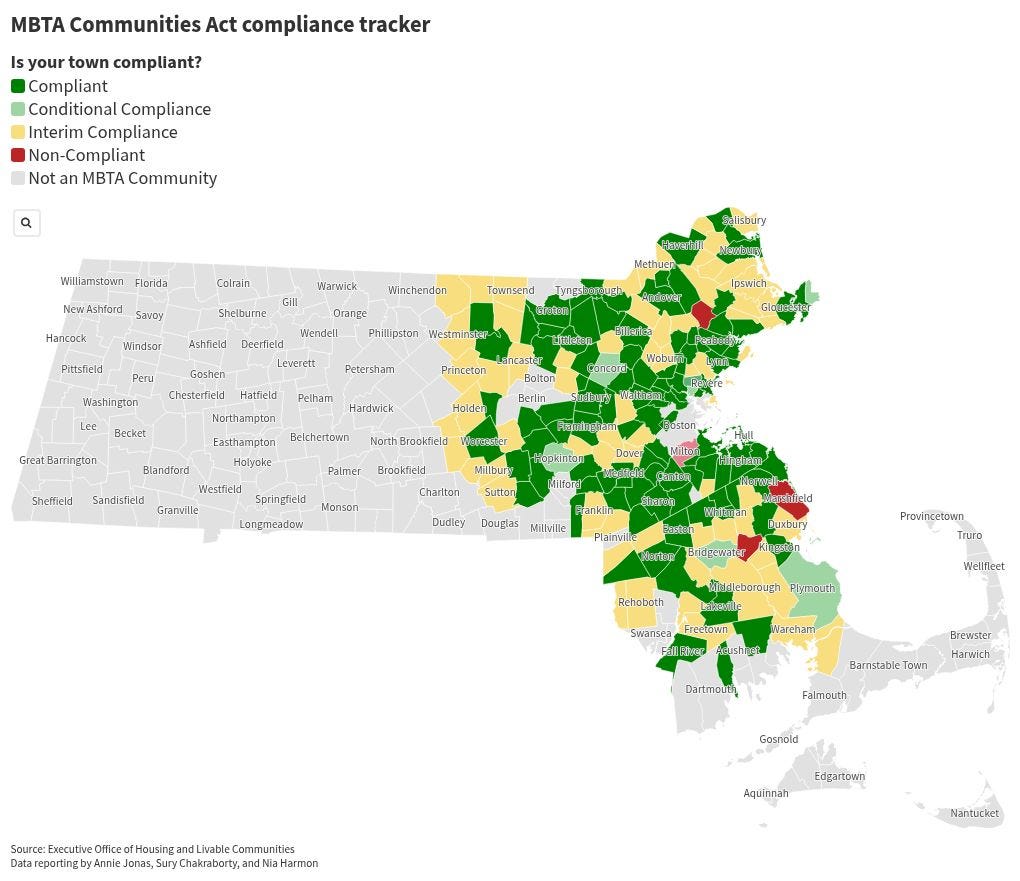
Take Hanson, for example. The town's Select Board noted that the community had "overwhelmingly defeated" the proposed zoning due to infrastructure concerns and the absence of funding support (WBUR). Holden filed suit to challenge its classification and the burdens placed on it. Middleborough, while ultimately reaching a compromise, originally resisted on the grounds that existing Smart Growth zoning already met the law's objectives.
Marshfield, too, rejected proposed zoning amendments multiple times at Town Meeting and eventually filed a lawsuit seeking either funding to comply or exemption. Their position was simple: comply or not, don’t bankrupt us for trying to manage our own growth responsibly (boston.com).
The state's response? Punishment. In February 2025, Marshfield was deemed non-compliant and suspended from multiple grant programs. The town and others joined a broader legal challenge to the Act, arguing that it imposes an unfunded mandate—one which the state has no right to enforce without providing financial support.
That challenge met resistance in the courts. On June 6, 2025, a Superior Court judge dismissed the lawsuits filed by nine municipalities, including Marshfield, Holden, Hanson, Duxbury, and others. The court ruled that the law does not constitute an unfunded mandate, largely because the financial burdens were considered "speculative." It also reinforced a sobering principle: towns remain creations of the state (boston.com).
Let that sink in. Local voters can reject compliance, town leaders can file legal appeals, but at the end of the day, the state calls the shots. And those shots include withholding critical grant funding from towns already facing tight budgets and aging infrastructure.
This is more than a policy dispute—it’s an existential moment for local governance. What does it mean for self-determination if a town can vote down a proposal democratically and still be punished financially for its decision? The state’s approach feels less like partnership and more like coercion.
To be clear: Massachusetts does need more housing. Zoning reform is part of that solution. But there is a right way to lead, and this isn’t it. Instead of listening to local voices, the state is applying a one-size-fits-all policy, ignoring unique local contexts, and punishing the very communities it claims to want to help.
The Executive Office of Housing and Livable Communities has distributed over $7.8 million in technical assistance to support compliance, but this is a drop in the bucket compared to the actual infrastructure needs towns face when expanding density. Meanwhile, non-compliant communities face exclusion from programs that fund essential public works.
We must ask: is this how we foster smart growth? By threatening to bankrupt towns? By overriding democratic decisions? By pushing communities into compliance through fear?
This is not just about zoning. It’s about the relationship between the state and its municipalities. It's about whether we believe in collaborative governance or top-down mandates. The MBTA Communities Act, in its current form, leans too far into the latter.
As someone who works in municipal finance, I see firsthand the impact that lost grant funding can have on a community. Roads go unpaved. Water systems go unrepaired. Projects are delayed. But I write this as a private citizen, not on behalf of any municipality. The views expressed here are mine alone.
Good policy should be rooted in good governance—incentives, resources, and respect. The MBTA Communities Act got the policy half right. Now it’s time for the state to get the governance right, too.
If you want more grounded commentary on Massachusetts policy, municipal finance, and the intersection of state and local government, subscribe below to stay informed.